


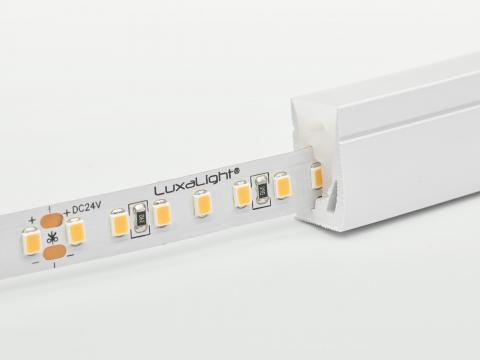
LuxaLight LED-strip Deep Red 660nm Protected 2835 (24 Volt, 140 LEDs, 2835, IP64)
LS24DR2140X2835PLX
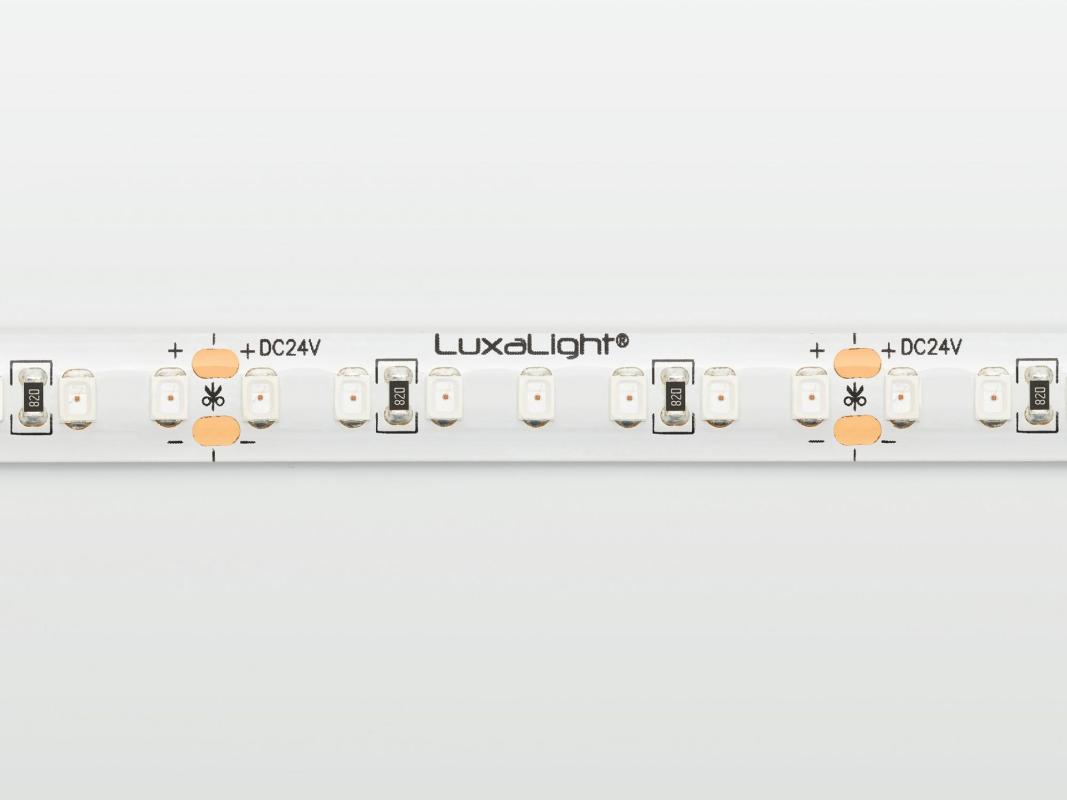


Technical specifications
General
Brand
LuxaLight
LEDs / meter
140
LED type
2835
Length per reel
5 m
Length per segment
50 mm
LED strip width
10.00 mm
LED strip thickness
4.00 mm
PCB color
White
Mantle material
Silicon
Mounting
3M tape VHB4905
Warranty
5 years
Lifetime
70000 hours
Lighting
Wave length
660 nm
BIN
3 SDCM
Beam angle
120 °
LB waarde
L90B50
Measurement results
Illuminance (Lux)
(Object length: 200 mm)
| 24V | |
|---|---|
| 5cm | 5968 lx |
| 10cm | 2172 lx |
| 15cm | 1120 lx |
| 20cm | 680 lx |
| 25cm | 457.1 lx |
| 30cm | 346.2 lx |
Total PPFD umol/m2 (PAR 400-700nm)
(Object length: 200 mm)
| 24V | |
|---|---|
| 5cm | 424.25 umol/m2 |
| 10cm | 155.63 umol/m2 |
| 15cm | 81.35 umol/m2 |
| 20cm | 50.41 umol/m2 |
| 25cm | 34.04 umol/m2 |
| 30cm | 25.79 umol/m2 |
Peak wavelength
(Object length: 200 mm)
656 nm
Peak irradiance
(Object length: 200 mm)
| 24V | |
|---|---|
| 5cm | 3.3 W/sqm |
| 10cm | 1.2 W/sqm |
| 15cm | 0.62 W/sqm |
| 20cm | 0.38 W/sqm |
| 25cm | 0.26 W/sqm |
| 30cm | 0.2 W/sqm |
Total irradiance
(Object length: 200 mm)
| 24V | |
|---|---|
| 5cm | 82.91 W/sqm |
| 10cm | 30.21 W/sqm |
| 15cm | 15.58 W/sqm |
| 20cm | 9.41 W/sqm |
| 25cm | 6.29 W/sqm |
| 30cm | 4.8 W/sqm |
Electronics
Working voltage
24V
Current / meter
1.00 A / meter
Power consumption per meter
24.00 W / meter
PCB material
Copper
PCB thickness
3.0 oz / ft2
Environmental
Storage temperature
-40 ~ +80 °C
IP class
IP 64
Directives - standards - certificates
Directives
RoHS
CE
Safety standards
EN60598-1
EN62031
IEC62471
Services and specializations
Related
LuxaLight Industrial LED Fixture Transparent cover Deep Red 660nm 24.2x16mm (24 Volt, 2835, IP64)
Barcode Scanning
Machine Vision
LuxaLight Industrial LED Fixture Transparent IP68 Deep Red 660nm 24.2x16mm (24 Volt, 2835, IP68)
Barcode Scanning
Machine Vision
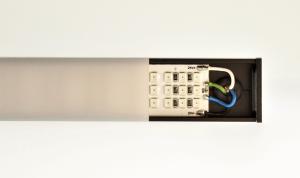
LuxaLight Industrial LED Fixture Opaline cover Deep Red 660nm 24.2x16mm (24 Volt, 2835, IP64)
Barcode Scanning
Machine Vision
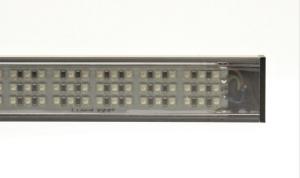
LuxaLight Industrial LED Fixture Polarised cover Deep Red 660nm 24.2x16mm (24 Volt, 2835, IP64)
Barcode Scanning
Machine Vision
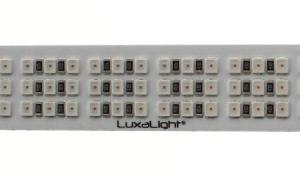
LuxaLight LED Engine Deep Red 660nm Protected (24 Volt, 108 LEDs, 2835, IP64)
Barcode Scanning
Machine Vision
Product description
The LuxaLight LED Strip Deep Red Protected provides intense 660 nm illumination for industrial applications such as photochemistry, machine vision, inspection, and signaling. With 140 efficient 2835 LEDs per meter and IP64-rated silicone protection, it is built for continuous use in harsh environments. Its flexible design (5 m reels, cuttable every 50 mm) integrates easily into production lines, reactors, and inspection systems. An optional NTC sensor can be added for thermal monitoring via the MaNima Pollux Industrial System.
Key Specifications
| Property | Value / Description |
|---|---|
| Wavelength | Deep Red 660 nm |
| Irradiance (5 cm) | 83 W/m² (total) |
| Illuminance (5 cm) | 5,968 lx |
| PPFD (5 cm) | 424 µmol/m²/s |
| Beam Angle | 120° |
| LED Specifications | 140 LEDs/m, 2835 SMD |
| Dimensions | 5 m per reel; cuttable every 50 mm; width 10 mm; height 4 mm |
| Power & Consumption | 24 V DC; ±1 A/m; ±24 W/m |
| Protection | IP64 – silicone coating, dust- and splash-resistant |
| Thermal Monitoring | Optional via external NTC sensor (Pollux-compatible) |
| Mounting | 3M VHB-4905 tape |
| Operating Temp. | −20 °C … +60 °C (storage −40 °C … +80 °C) |
| Standards | RoHS, CE, EN60598-1, EN62031, IEC62471 |
Applications
- Photochemical processes & reactors – curing and surface activation
- Machine vision & inspection – improved contrast on reflective or dark materials
- Industrial signaling & status indication – deep red for warnings or process status feedback
- Horticulture & agriculture – supports flowering and photosynthesis where deep red is required
- Biological & medical research – suitable for photobiomodulation and related studies
- R&D & laboratory setups – experiments requiring precise deep-red illumination
Also applicable in R&D and specialized lighting setups.
Benefits for Engineers
- High, consistent 660 nm output with uniform 120° distribution
- Flexible, modular design (cuttable every 50 mm) for easy integration
- Industrial-grade IP64 construction for continuous operation
- Expandable with optional NTC sensor for thermal monitoring via Pollux
- Simple 24 V integration and low maintenance
- Reliable performance for production environments
Integration with MaNima Pollux Industrial System
- Real-time thermal monitoring via optional NTC sensor
- Pulse and strobe modes for flexible output control
- Automatic thermal protection through system control
- Seamless PLC/SCADA integration
- Open UDP API for advanced control and logging